

"deepfake"
keeping your heart alive in the AI age

Decades ago, the internet was created, and everything changed. I had literal dolls, and then I had StarDoll, my very own virtual doll. I played with my toys, and then I played with my computer: dress-up games, kissing games, puzzle games, RPGs, all through the power of the internet. There was the real me, with a body, and the virtual me, not so much a body as it was an experience of existence. Through the net, the physical became a blur.
But even in the physical, digital innovations were blurring by. I remember once cleaning out our house during a move and my Dad finding an old floppy disk of his, and laughing at how it had become obsolete, replaced by USBs, which have since been replaced by USB-Cs, and increasingly, with the cloud, our very own invisible storage space.
I remember my Grandma using a touchscreen phone for the first time, about ten years ago, to video call her cousin in America, fascinated by the digital ability to transcend borders. She had existed in a time when the idea of a mobile phone was once ludicrous, when the best way to speak across borders was to send letters, and now, at the press of a button, she was looking through the peering glass to Houston.
December 2016: Grandma Mary on a call with her new phone, her old Nokia in her lap.
Throughout this millennium, we have existed in a very fast-tracked digital age, marked by the rise and fall of various innovations, all designed to make our lives easier and provide a convenience we didn’t even know we needed.
And now it’s a new year, and we’re talking about AI. To a degree, the term artificial intelligence is really just marketing. AI is nothing more than a series of algorithms, albeit advanced algorithms, but not so far off from what we see in the algorithms of social media apps, designed to study our desires and keep our attention. In truth, ‘AI’ has been with us for quite some time, but now it has a face, and now it has a name.
We’re witnessing a major shift in the world, perhaps as big as when the Internet was created. The way in which we engage digitally, and in our day-to-day lives, is going to transform over the course of the next decade, because of these advanced algorithms we call AI.
I don’t need to give you a moral opinion on AI because, to be honest, it’s pointless. Not because the environmental detriment AI causes with its massive water use doesn’t matter, because it does, and it’s alarming. But because we’re past the point of speaking about AI in a moral binary. It’s here, and likely will be continuously evolved in the coming years to make sure it stays that way. So what can we do?
a growing problem
When we speak about issues with AI, the biggest is the current lack of adequate regulation. Perhaps the truth is that AI is changing human society faster than lawmakers can keep up, but when one data center uses enough water in a day to rival that of a town, or when you see a super alarming trend of men using GrokAI on Twitter to virtually undress women, shouldn’t that create some urgency?
Beyond the legal lines, there is also the surreal quality of AI-generated digital content. Have you scrolled through Pinterest recently? It’s becoming littered with AI content. Or TikTok and Instagram, where our feeds are becoming increasingly entrenched in AI slop. Convincing deepfakes are being shared, altering our sense of what is truly happening in real life. AI musicians, like Xania Monet, and AI-generated movie scripts are gaining notoriety. We can’t escape AI wherever we look, it seems. It’s already deeply embedded everywhere.
the coming renaissance
Now more than ever, it’s apparent: we cannot trust everything we see online. With the digital being devalued with AI-slop, the real will only increase in value. Porsche recently released an animated ad that they promoted as fully human-made. In the same vein, Gucci released an AI-generated runway video that was met with a lot of disdain from users online.
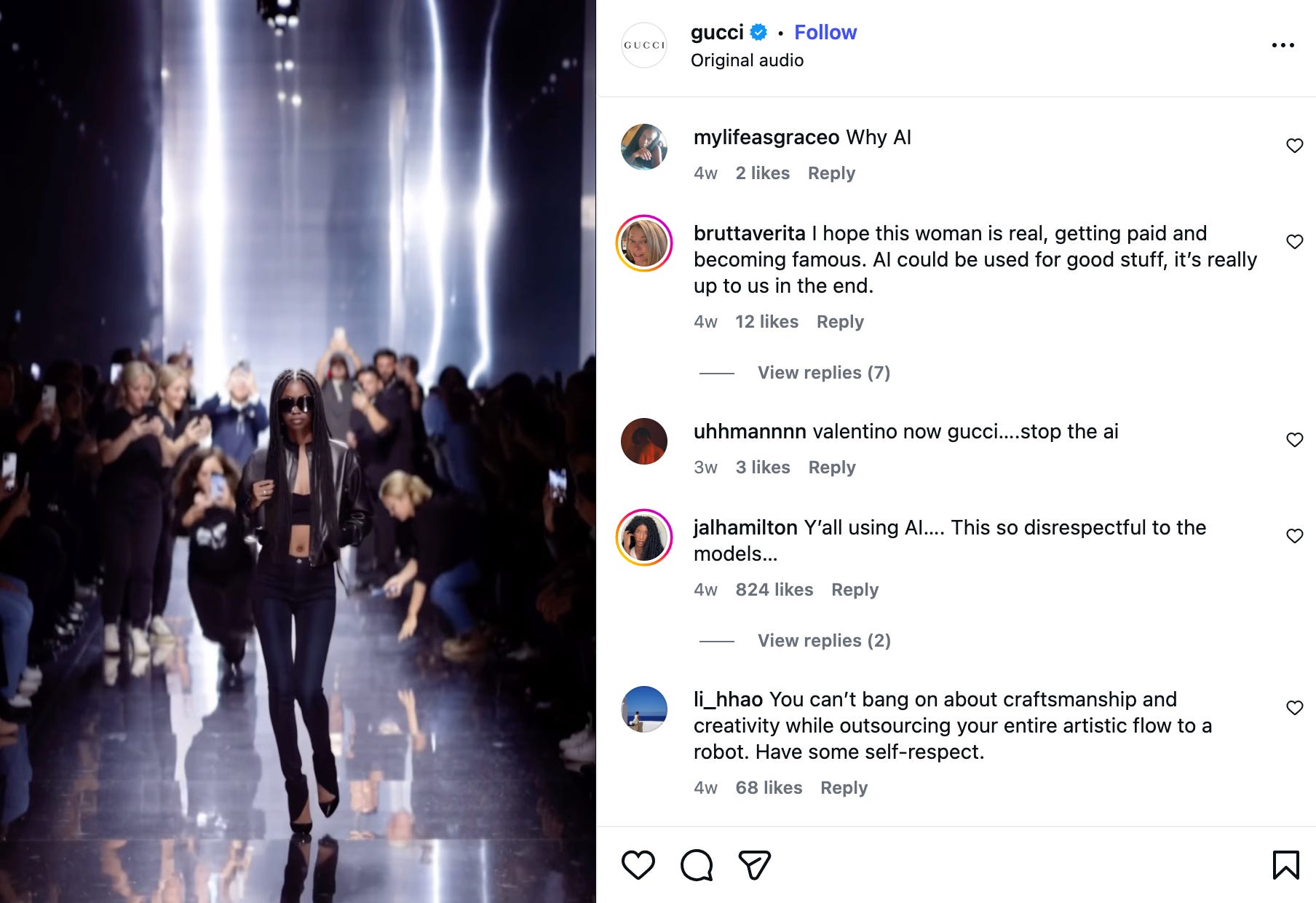
Is humanness the new luxury? If that’s the case, then we’re heading into an era where, eventually, convenience is rejected, or at the very least looked down upon, and the great human struggle is extolled. The grit of creating with our hands, thinking with our brains, and knowing how to do things is a skill that will increase in value as we continue to digitally evolve.
Will it eventually lead to another Renaissance period? Where we totally forsake AI, and celebrate the lost appreciation for intellectualism, meticulous art, and the cultivation of knowledge?
Ultimately, this AI age is very on brand with our human nature. Cycles of life-death, dark ages succeeded by renaissances, creation to our own detriment. We’re creating circles around ourselves, but perhaps even the hubris is an attempt to grip control over our unknowable experience, to make it controllable, to introduce predicatability, to make it safe.
But while some will succumb fully to an AI-backed life of convenience, there will always be those who write the code and design the algorithms, who know the trick behind the magic, and they are the ones who will hold all the cards in an era of complacency.
So is this a plea for more creation? Possibly. But not just any creation, it’s for creation that feels meaningful, that’s not instant, that takes time, that looks imperfect, that has grit. These are the last hallmarks of what it means to create from a human vantage point. These are the qualities that no algorithm can ever imitate.
So my main resolution this year is to create more with my hands, to write even though it’s imperfect, to read, and to find a life that exists outside of virtual confines. To begin to choose grit over convenience, because one day in the near future, that choice might just be the most important one.
Thanks so much for reading!
Cover image by Hajime Sorayama.
connect with nneka:
📸 ig - @nnekauwe
📹 yt - @nnekaoflove
🎶 my spotify
📚 my goodreads
💌 email me: nnekauwefoh@gmail.com
This is so spot on. Is humanness the new luxury? I just had a friend share a “surprising” video of a white libertarian man delivering an anti-racist leftist message. It was AI. I had to tell him after he’d sent it to a bunch of people who were just as surprised. Sigh.
This is absolutely true.
Nice write up